Archive for category Internet

How to Make a Game for Free

I'm completely floored by the quality of some free (as in beer) software these days. Some of it is open source, but I'm not concentrating on that in this post. I'll be concentrating on how to save a ton of money and still create a high quality game. So if you are interested in making a game, and you don't want to shell out a lot of money for the tools to do so, keep reading.

Game development can be a tricky endeavor. Being able to write code and do simple math are definitely a prerequisite. However, some game developing environments and frameworks take a lot of the busy work out of the coding experience and let you focus on the game more directly. Perhaps the easiest language to start developing games with is Java. It's also very powerful. Minecraft is a very successful Java game. There is, however, an easier way to make games, and for some reason I'm just now discovering it. It's called Unity3D.

There are two versions of Unity3D: free and pro. The free version has all the features you need to create a game, but Pro does have its advantages. The pro version costs $1500, however, and that is not within the budget of most small independents. So, a good plan is to start with the free version, get really good with it, and create a game which sells well. From your profit you can purchase the pro version. I've been learning Unity3D for the last two days and I'm amazed at its features. I've developed small games in Java, so I'm not a terrible coder. I usually shy away from applications which try to make game development easier (for instance Dark Basic). I stay away from them for the same reasons that I don't use a GUI interface to create web layouts, you end up being limited by the ease of use.

I was afraid that Unity3D fit into this stereotype, but I have to say that it's a great piece of software. The GUI is smart. If you create a script for an object, the GUI automatically knows what to do with the object properties you create in the script. For instance, lets say you create a character object and add a script to control his movement. You may create a class variable like:

boolean isWalking = false;

If you save this change in your script and then go back to the Unity3D inspector you'll see a new checkbox called Is Walking. It's small little helper features like that which make it a joy to work with.

So, in case you didn't catch on, my first piece of free software is Unity3D. Even if you are a game developing guru, this will make your life much easier. It also has the ability to export to Android, iOS, Windows, Linux, Mac, PS3, Xbox360, and Wii.

Unity3D doesn't handle all your work though. You still need to create your assets in other programs or buy them from the Unity asset store. Personally, I want to make my own assets so I have full legal right to them and they aren't just generic assets which others can have in their games as well. So, you need models, textures, and sounds. There may be other types of assets that you'll need but these are the assets on which I want to focus.

Models can be created in Blender. Blender is comparable to high-dollar applications such as Maya and 3DSMax, except it's completely free. I've never had any training on how to make models, but when a piece of software like this is available for free, I can't help but want to dive in and learn how to use it. With Blender, you can create full length animated movies as well. Want to learn how to use it? Check out these Blender video tutorials. They are awesome and will help you master Blender in no time. Modeling is no simple task, especially if you are adding rigging and such, but it's very rewarding. You can also create assets in Blender which can be sold on the Unity Asset Store.  So if your passion is not to make games but to make in game objects, you can profit from selling your work.

Textures are added to models to make them look like real world objects. These can be created with the Gimp, which is a free image manipulation application. Some people say that The Gimp is no where as powerful as Photoshop, but I tend to lean toward the side that says you can do anything you want with either, you just have to know your way around the tool that you are using. With the Gimp you can many things, but the two we are interested it is textures and spritesheet (in case you are making a 2D game).

Finally, you need sound effects and music. You could purchase both, but again I want to create all of my game content. So, I suggest looking at Audacity. It's a great multi-track recording studio for audio. You could make music with it, but you're looking at a higher investment when you have to purchase music gear. For sound effects, it is only limited by your imagination. I've not decided what I'm going to use for music yet. I have a decent midi controller, so I may create nice midi backing tracks using something like MultitrackStudio, which will do midi and audio. I just found it, so I'm not sure how good it is. It looks promising from the screen shots.

»crosslinked«

No Comments

Clickbank Analytic Software

There's a site called cb-analytics.com which has always been a great resource for information on Clickbank products. However, I've always found the site hard to navigate and I wanted a site that showed some of the "hot" clickbank products. So, I've written a site called cbniches.com which I hope will rectify these issues.

The site shows all the latest products in each category and shows gravity and earnings per sale. It also has a graph for each product to show gravity over time. I think this will be pretty helpful to affiliate markets looking for new products to promote on Clickbank. Check it out at http://cbniches.com. I wrote it with the latest version of my LavaPHP framework, another product I've been developing as open source. LavaPHP can be found on github, but it's still in early development.

, , , ,

No Comments

Increasing the size of tmpDSK and /tmp in a CPanel Environment

I recently ran into an issue in cPanel after recompiling Apache with some new settings. I enabled the eAccelerator extension in my EasyApache configuration for PHP. Now cPanel uses a default size for its /tmp mount of 512mb. I found out rather quickly that this isn't enough for eAccelerator. I actually ended up resetting this value to 4096mb (4GB). As a reminder to myself and so anyone else looking for the solution to this problem, I will outline what needs to be done below.

First, ssh into your server and login as root or su - root after logging in as a regular user. Now use the power of the command line. Don't panic!

Stop Apache, MySQL, and cPanel

1
2
3
service httpd stop
service mysql stop
service cpanel stop

Next unmount the existing /tmp

1
umount -l /tmp

Remove /usr/tmpDSK

1
rm -rf /usr/tmpDSK

Next, use your favorite editor (Vim in this example) to change the config file for the tmpDSK

1
vim /scripts/securetmp

Search the file for "tmpdsksize" (in Vim type /tmpdsksize and hit enter). The line should look like this by default:

1
my $tmpdsksize     = 512000;    # Must be larger than 250000

Change the 512000 to a higher number in Kilobytes. For my 4GB, I changed it to 4096000.
Save the file (vim :wq enter).
Run the script...

1
/scripts/securetmp

Answer y to the two questions it asks.
Finally start your services back up.

1
2
3
service httpd start
service mysql start
service cpanel start

That should have you set with more /tmp space.

, , , ,

No Comments

Best Godaddy Alternative Registrar

Many of you may be die-hard GoDaddy users. GoDaddy's support of the SOPA has led many people to start looking for a new registrar, including myself. After a boycott, GoDaddy broke away from its support of SOPA. However, their initial support for the legislation was enough to turn me away. I do not plan to do any further business with them and will be slowly migrating my existing sites over to another registrar as time goes by.

In my search for a GoDaddy alternative, I found that I really like NameCheap.com. They offer good rates on domain transfers and registration. I also like their control panel much better than GoDaddy. They don't have as much up-selling going on when you register a domain. I always found that annoying about GoDaddy. I also didn't care for GoDaddy's domain manager. Once, I tried out GoDaddy's Windows hosting as well. It was terrible. So if you are looking for a viable alternative to GoDaddy, you should definitely give NameCheap.com a try.

, ,

No Comments

Reset a WordPress password

I'll make this post short and sweet. Let's say you've forgotten your login for a WordPress site. To reset the password to something new, you can simply use a SQL query. If you have access to PHPMyadmin or the MySQL command line, this is really straight forward.

From PHPMyAdmin, open the database for the WordPress installation. If you don't know which database to use, check out your wp-config.php file inside your main WordPress installation folder. You'll find constants defined in that file for your database name and database user. Once you've found the database, you can execute a SQL statement by clicking the SQL button. In there, type:

 
UPDATE wp_user SET user_pass = MD5("yourpassword") WHERE user_login = "admin";

That's assuming that your username is "admin". Change it to whatever username you are using. Once you run that SQL statement, your password will be set to whatever you put in "yourpassword". Both the username and password need to be quoted in the SQL statement.

To do the same thing in the MySQL command line, connect to the database with:

mysql -u<username> -p

Substitute <username> with your actual username from the wp-config.php file.
You will be prompted for a password. Use the password from the wp-config.php file.
Once you are logged into the mysql command problem type:

USE <databaseName>

Substitute the actual database name from the wp-config.php file.
Finally, type the update statement above and hit enter.

After you've updated the table via SQL, you should be able to login to your WordPress installation.

, ,

No Comments

A Free “Net Nanny” Solution using OpenDNS

Many internet users understand that a large portion of the internet is pornographic in nature. Many parents want to restrict their children from being able to view pornographic sites, and with sites like Youporn and other "porn tubes" which do not require identification or a credit card, this is even harder to restrict. There are programs available to block such sites, but sometimes they aren't very effective, and there are easy ways around them.

There is a good alternative for parents in their search, however. OpenDNS, which is a free DNS service with many features, has built in site blocking capabilities. You simple sign up for an OpenDNS account at http://opendns.com and configure your router to use the OpenDNS servers. That last part isn't as hard as it sounds, but it's different on various routers. Typically the DNS settings are in the main router configuration settings. It will typically be set to automatically use the DNS servers provided by your ISP. You should be able to use manual DNS servers, however, and you can find the IPs for these servers at the bottom of your OpenDNS account page.

Once you have your router using OpenDNS's servers, you can configure your home network's settings on the OpenDNS accounts page. There are various levels of blocking, plus you can block individual domains if you want. They also have good stats available, if you enable it. This will track all domain name requests and show you what everyone on your home network has been looking at. I'd say a few wives just raised their eyebrows.

Of course, with enough know how, one can get around these types of blocks, just like any other block. Most children will not know how to do this, however. Tech savvy teenagers may have more ability to get around these blocks, but once they are at the point where they'll go to such great lengths to look at porn, just let them do it. They aren't going to listen to you anyway :P

, ,

3 Comments

GoDaddy Alternatives | Boycott GoDaddy

Due to its support of SOPA, many people are calling for a boycott on GoDaddy. At first GoDaddy was laughing because of the planned boycott. After about 24 hours, their tone changed and they proclaimed that they were no longer supporting the legislation. Many people are looking for alternatives to Godaddy.

I searched for a bit and found that about the best deal in town is namecheap.com. There is a transfer fee for moving domains over to them, but you get a free year of registration with the transfer. So for around $7 bucks you can transfer and renew a .com. If you have a few months left before it's time to renew your .com, you can still transfer the domain and get a free year along with the remaining time of your current registration.

Check out their deals. Let's show GoDaddy that we do not like their support of this unconstitutional legislation.

NameCheap.com

,

No Comments

Funny vWorker Job Posting


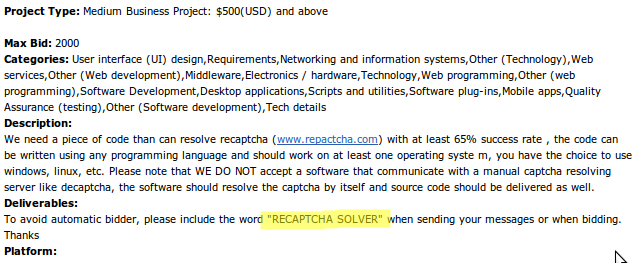
One of the most entertaining emails I received daily is the vWorkers mailer. It is a list of all the latest freelance work that is available at vWorker.com. It's entertaining because of some of the amazing things some people want written for peanuts. There are many foreign programmers waiting on jobs like this, and they are willing to work for near nothing. However, it still gives me a good chuckle when someone thinks they have come up with some amazing idea and just need someone to code it. Why is that funny? Because most people have good ideas, even those idiot code monkeys. The main difference is that a code monkey realizes when an idea is ridiculous.

Today's job posting was funny for a whole new reason. The irony in this post is just amazing. Here is a screen shot of the listing. I've highlighted a clue to the irony. Enjoy!

, ,

No Comments

The Best PHP Framework?

I've been really interested in using a PHP framework. One thing holding me back is deciding which one to work with. It seems that every time I start looking at frameworks, I end up deciding to just code everything manually. The major contenders seem to be Yii, Zend, Symfony, CakePHP, and CodeIgnitor. However, I have no idea which one I'm going to use. It's hard to decide without learning the ins and outs of each one and making a good decision based on that knowledge.

My latest attempt was with the Zend framework. I was getting into it and realized that most of the documentation for setting it up bases the setup from a virtual host in Apache. This would be fine, but it actually makes development and deployment overly complicated for me. My development environment is a Linux machine that is my main desktop. My production server is my own dedicated server with CPanel. Zend doesn't work very well with this setup from what I can tell.

I want my site to transfer easily between the two environments. I like them to be self-contained as well. I want to throw the framework into a lib folder or link to it in some way. I don't like that the forward-facing web site is in the "public" folder. I want the root of the website to be the forward-facing public website.

I would really like to use Zend because it has a lot of good extensions for utilizing various web services.

I'd like to hear from others. Which framework would you recommend and why?

, , , , ,

No Comments

What’s Killing Linux and Software Freedom?

I know many will say "we knew that already" when they read what I'm about to write, but I just came to this realization today. I was reading a blog title "I miss using Linux". The author was describing some of the reasons he can't avoid using Windows.

There are many good reasons like the ones he offers. Some people want to game, but game companies just don't make games for Linux because it isn't popular enough. Others need certain programs that are only available for Windows. Whatever the reasons, it's not going to be the "year of the Linux Desktop" any time soon.

One part that really stood out to me about the post was the reiteration that Photoshop was a main reason for not using Windows. I would actually go so far as to say that the entire creative suite is a major reason more people don't switch to Linux completely.

Sure, one could possibly run it in a VM but that's not a good solution. If you need a VM of Windows, why not just run Windows, right? That's the correct reasoning if you ask me, and I'm a Linux advocate. The problem could be that more people are procrastinating truthfully. They simply don't want to switch completely or don't feel comfortable enough in Linux to use it full time. I don't think this is the prime reason, but for some it could be a factor.

Adobe is the problem, at least in my mind. Adobe is the last non-open company. Microsoft office uses an open document format finally. There is a lot of compatibility with Open Office. Most other programs have decent open source alternatives. Even Photoshop has a decent open source alternative in the Gimp, but some people don't think it is enough. Adobe has a lock on a lot of the media on the web right now with Flash, even though there are better alternatives to using Flash, most sites use it.

Adobe is holding back Linux. Rather, our dependency on Adobe products is holding back Linux tremendously. There would be a lot more people to adopt Linux if the Creative Suite was available in it. There would be a lot of people adopt Linux is Flash was no longer the defacto standard for media on the web.

Apple has the right idea by not including Flash support on the iPhone. This will help push us away from the closed-standard. I'm for this change.

, ,

No Comments