Archive for category Tips
How do I Block and Unblock Internet Sites?
Posted by Randy in Internet, Networking, Tips, technology on August 1, 2009
Apparently this is a question many people want asked so I'll touch on what I use to block/unblock internet sites from my home network. This method will not require one to purchase any additional software or anything. It is designed specifically to be the low cost effective solution.
First of all, your home router controls all of the traffic going to an from your home computers. Some people don't have routers. The modem, whether it be a DSL, Cable, or dialup modem, handles their routing. These instructions will work for those people as well, but anytime I mention the router, please understand that if there is no router, the modem will be doing all the work.
The router software for various models of routers are different, so it is nearly impossible to have a step-by-step howto for each of them here. Instead, it's suffice to say that most routers have a block/unblock function. Most even let you time these blocks/unblocks. So one can set up rules as to when certain sites can be viewed.
Refer to your router's manual for these instructions. It is usually rather easy.
There is a further step that can either be used in conjunction with the router blocks or by itself entirely. This method involves signing up for a free service call OpenDNS.
OpenDNS is a free service that I've used for a little over a year. It gives you a great DNS service, plus allows you to do various other interesting things like protect your home network. Basically, all one has to do is sign up for the account and change their DNS settings in the router to the IPs provided by OpenDNS. All future DNS request will go to OpenDNS.
I should probably first explain what DNS is to begin with. DNS stands for Domain Name Server/Service. When you type google.com into your web browser, your computer has no idea what google.com is. It's oblivious. First it has to query the DNS server. Usually the IP of the DNS server is provided by your ISP. In many cases, the ISP provided DNS server lags behind a bit. You computer asks the DNS server where it can find google.com. The DNS server then responds with the IP address for google.com. Your browser then knows where to fetch the information.
The DNS server configuration can be changed in your router. You will override the ISP defaults and put in the OpenDNS server IPs instead.
OpenDNS updates much faster than typical ISP DNS servers. When you buy a domain name and direct it to your hosting provider, it can take up to 72 hours for the DNS information to propagate across the internet. OpenDNS usually propagates within minutes.
Some of the protection OpenDNS offers is right up there or better than many parental block software. There are automatic settings to make it easy to block pornography or harmful sites. One can also specify sites to block. Anytime a local user tries to access a blocked website, they are told that it is restricted. This is great free service, and I hope this will help you block those unwanted websites, and if you have any questions drop a comment.
Slow wifi on iPhone 3GS
Posted by Randy in Apple, Internet, Networking, Tips, technology on July 24, 2009
I bought a new iPhone 3G S yesterday. These things are very nice, and I'm not an Apple fan boy by any stretch. One thing that was bugging me, however, was the slow speed I was getting from the wifi. I was getting faster speeds from the 3G network than my home wireless, and this is while I was sitting right next to the router, so it wasn't a signal problem.
I found the solution to this after reading through many, many forum posts. I saw others were having the same problem as me and were getting responses from people like "reboot the router" or "reset your network settings on the iPhone." This is all well and good and I'm sure those people meant well but there was a big problem with their responses.
First of all, everyone having this trouble said that the wireless worked fine on their computers but not on the iPhone. Secondly, there aren't many settings to "reset" inside the iPhone's network settings. There's just not anything in there that would cause this type of issue.
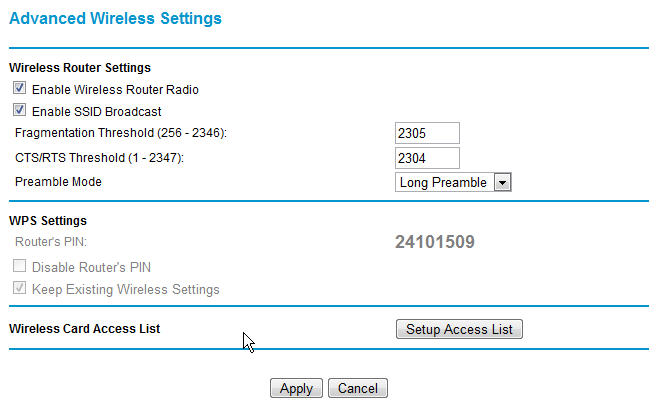
The solution to the problem ended up being an advanced setting on the router itself. From what I can tell of the issue and it's solution, the iPhone's wifi is just a bit more picky than a standard PC wifi device. Here are the settings I eventually had to change on my Netgear router.
The important items here are the fragmentation threshold and the CTS/RTS threshold. Each of these were set to their max value previously. After changing these two settings, my iPhone started working like a champ.
If you are experiencing the same problems with your iPhone or iPod Touch's wifi, change these settings on your router. Also note, these settings have slightly different names on some routers. Refer to your router's manual for more info.
Edit: I've gone much lower with these number with much success for my less powerful mobile devices. Going too low does seem to cause issues with more powerful computers on the wireless network. Test this out with lower settings and post your success or failures in the comments.
| Apple Mac mini 166 GHz 1 GB 120 GB NOT WORKING | ![]() |
22 Bids | US $92.53 | 1h 21m |
| APPLE G4 125 GHZ MAC MINI 1GB RAM 40 GB HD COMBO 105 | ![]() |
20 Bids | US $173.00 | 3h 32m |
| Apple Mac Mini 142GHzCombo M9687LL B 142 GHz 51 | ![]() |
5 Bids | US $167.50 | 2h 11m |
| Mac Mini PowerPC G4 125GHz | ![]() |
13 Bids | US $200.00 | 54m |
| Apple Mac mini G4 M9686 B 125 GHz 512 MB 40 Gb | ![]() |
![]() |
US $250.00 | 6h 11m |
| Powered by phpBay Pro |
Digital Converter Box Coupon and How to Use it
Posted by Randy in Free Stuff, Good Deals, Internet, Tips, technology on June 17, 2009
If you are using an analog TV, chances are it no longer works correctly. As of June 12th all major broadcast companies are no longer broadcasting in analog. It's a strictly digital world now.There is a program to help everyone convert however, in case you haven't heard of it. It's at dtv2009.gov. You can go there and request two free $40 coupons from the government to purchase a converter box. If you have an analog TV and no converter box, you have to order a converter box to watch TV now.
After you request your coupons, the next step is to order your converter box. The absolute best deals on digital converter boxes are
here. They accept the government coupons and let you buy your converter boxes online at the best prices.
Right-click stopped working in Word
Posted by Randy in Applications, Tips on June 11, 2009
I had this problem with Word 2007 today recently. I thought it would be helpful to post the fix that worked for me. I'm not exactly sure what caused the problem. From what I've read it can be caused by some add-ins. The results of this issue are 1.) no access to Word options(they will be greyed out) and 2.) mouse clicks inside of a document will not work. This limits your ability to use Word completely. It was a rather frustrating fix. I first tried repairing my Office 2007 installation. This didn't fix the problem and actually the repair crashed. I should point out that this is on Windows Server 2008, but others have had this issue in Vista.
After the repair crashed, I tried reinstalling Office. This crashed a few times and I realized I needed to run it as an administrator. Running it as an admin allowed me to uninstall Office but after reinstalling it, I got the same results as before. This led me to believe that maybe there was a permissions issue with the executable. I tried running WinWord.exe as an admin. This didn't help either. So I decided it must be a profile issue. I went through my profile (local and roaming) trying to find all mentions of Office and Word. I deleted those and still had the issue. Sometimes this will fix issues, but in this case it didn't.
After some research I found that the problem could be cured by deleting some registry keys.
Just open regedit. Browse to HKEY_CURRENT_USER\Software\Microsoft\Office\Word
The version number should be 12.0 but I believe 11.0 could be effected by this issue as well. At any rate, select Data. Then, choose File -> Export. Create a backup of the branch. You can name it whatever you want. After you have saved the backup, delete "Data". Close regedit and start Word.
The problem should be alleviated.
Make Twitter Better
Posted by Randy in Applications, Tips, Web Development on May 26, 2009
One of the things I like about Twitter, believe it or not, is the simplistic design. There's not a lot of useless options. There not many things to click on at all really, compared to other sites. There are a few missing items that should be on the site, however. I just recently installed a Firefox extension that accomplishes everything I need.
I've found that a lot of the twitter "clients" are lacking. For instance, I can't easily search and follow people from TweetDeck. I really like to just use the web client. I only thing that I could use on the web interface is a notification of @ replies. Every other option that I found useful in the clients is now available on the web client via Power Twitter Firefox extension. There's also a few features I wasn't expecting. For instance, Song.ly is now integrated. I had never tried Song.ly until I installed this extension. I love it.
Check out the extension. It's worth it if you Tweet much at all.
Just How Relevant is Google
Posted by Randy in Internet, SEO, Tips, Web Development on May 1, 2009
We have all come to expect good things from Google. In fact, many of us have come to believe that Google is the best at everything they do. This is especially true with their original application, their search. For the past few years Google has ruled the search market. It got there by making the most relevant search results appear every time a user executed a search.
Those days may be over. Recently, I've noticed a trend that Google isn't giving very relevant content. I don't think I'm alone, and I have a pretty good idea why we are getting such bad results. It's not entirely Google's fault. There are many "white hat" and "black hat" search engine optimizations that are being used to manipulate the results. Marketers are trying to draw content to their sites. That's how they make money after all. SEO has been used ever since the first search engine. Google just seems to be lagging behind in making their algorithms detect unwanted SEO.
This isn't to say that those marketers are doing something wrong exactly. It's just that most of them are concentrating on Google. Google is, after all, the most popular search engine. They know what works to get ranked on Google, so they do it. They do a lot of it. This skews Google's search results, but doesn't necessarily effect Yahoo search results because Yahoo uses different algorithms to determine where a result ranks.
Google also is notorious for de-indexing RELEVANT sites by mistake. For instance, this site seems to have been de-indexed, and I've not been attempting to SEO this site much at all. It could be due to my use of a WordPress plugin called All-in-one SEO pack, though that really shouldn't have anything to do with it either.
Here is my single example that has been perplexing me for a month or so:
Once upon a time, there was a script for the XChat IRC client, called "XLack". This script is my favorite system information script for XChat. I've used it for probably 4 or 5 years. The home site for the script used to be xlack.tk. This was where everyone would go to download it. That site is now a parked domain. It has been that way for close to a year. If you search google for "Xlack", xlack.tk is still the number one site. It is no longer relevant at all. It's a parked domain. In fact, if one tries to find a site from which to download the xlack script, one finds that there are none listed on Google.com.
Now take that same search over to yahoo.com. A simple search for "xlack download" gives you this site, which has the relevant download link of the actual script. Yahoo.com provides more relevant results. Try it on any of your search and see if you don't get better results from Yahoo or even Live.com. I guarantee you'll have more success from them these days than you do Google.